Civil preparedness and resilience you can rehearse, on one picture shared by the council and everyone it works with.
NATO and the UK government now treat civil preparedness as part of national security, and much of the work lands on councils, Local Resilience Forums, critical services and the voluntary sector. Sinkaos gives them one shared operational picture that keeps working through a long power cut or a network outage, so plans can be exercised and then used.
Resilience is set nationally and delivered street by street.
NATO’s seven baseline requirements for national resilience ask Allies to keep government running, energy, food, water, communications and transport working, and to cope with mass casualties and large movements of people. The UK, a founding member of the Alliance, has its own programme on top: the Resilience Framework of 2022, the Resilience Action Plan of July 2025, and a Home Defence Programme with a national exercise planned for 2027. Households are asked through the government’s Be Ready campaign to be able to manage for three days while help reaches those who need it most.
In practice the work falls to a district council opening a rest centre for people evacuated from the next valley, to a water company running bowsers through a long outage, to a charity feeding a sports hall full of evacuees. They use different tools on different networks and often meet properly for the first time during the incident itself.
Two things tend to fail first: the shared picture of who is doing what where, and the communications that picture depends on. Read the background in our guide to NATO resilience requirements.
NATO’s seven baseline requirements, at local level.
What each requirement means for a council, a utility or a charity, and where Sinkaos helps, if it does.
| REQUIREMENT | WHAT IT MEANS LOCALLY | WHERE SINKAOS HELPS |
|---|---|---|
| Continuity of government and critical government services | The council and its incident team keep deciding and acting when buildings, power or networks fail | Operations that run offline and on a local field node, with roles, tasks and a decision record |
| Resilient energy supplies | Outage response, generators for critical sites, priority customers | Tracks generators, fuel runs and repair crews; cannot supply power |
| Dealing with uncontrolled movement of people | Rest centres, registration, transport and accommodation for evacuated or displaced people | Reception points, tasks and counters on the map; it is not a population register |
| Resilient food and water resources | Bottled water and bowsers, distribution points, stock and expiry | Distribution points, inventory with quantities and expiry, delivery routes |
| Mass casualties and disruptive health crises | Supporting the NHS with transport, shelters and volunteers | Coordinates support teams and logistics; not a medical or triage record |
| Resilient civil communications systems | Staying coordinated when mobile networks are overloaded or down | Offline-first apps, store and forward, local Wi-Fi nodes that sync when a link returns |
| Resilient transport systems | Closures, detours, evacuation routes, fuel and vehicle availability | Closures and hazards change routes, offline routing, vehicle readiness |
Requirements as listed by NATO. Sinkaos supports the people delivering them; it does not by itself make an organisation meet any of them.
A 72-hour regional blackout exercise.
-
T-14 dPlan with alternativesThe district council, the water company and a relief charity build one plan: bottled water stations, generator sites, bowser routes. Plan B covers a closed bridge, plan C a missing bowser.Mission planningPlan A, B, C
-
T-1 dPacks on every phone, a node at the council officesEach participant downloads offline maps and tasks. A laptop node at the council offices will serve the incident team over local Wi-Fi when the internet is gone.Mission packsField node
-
Hour 0The grid and mobile data go downThe exercise control switches off internet access. Teams keep reporting; reports queue on phones and on the node.OfflineTraining mode
-
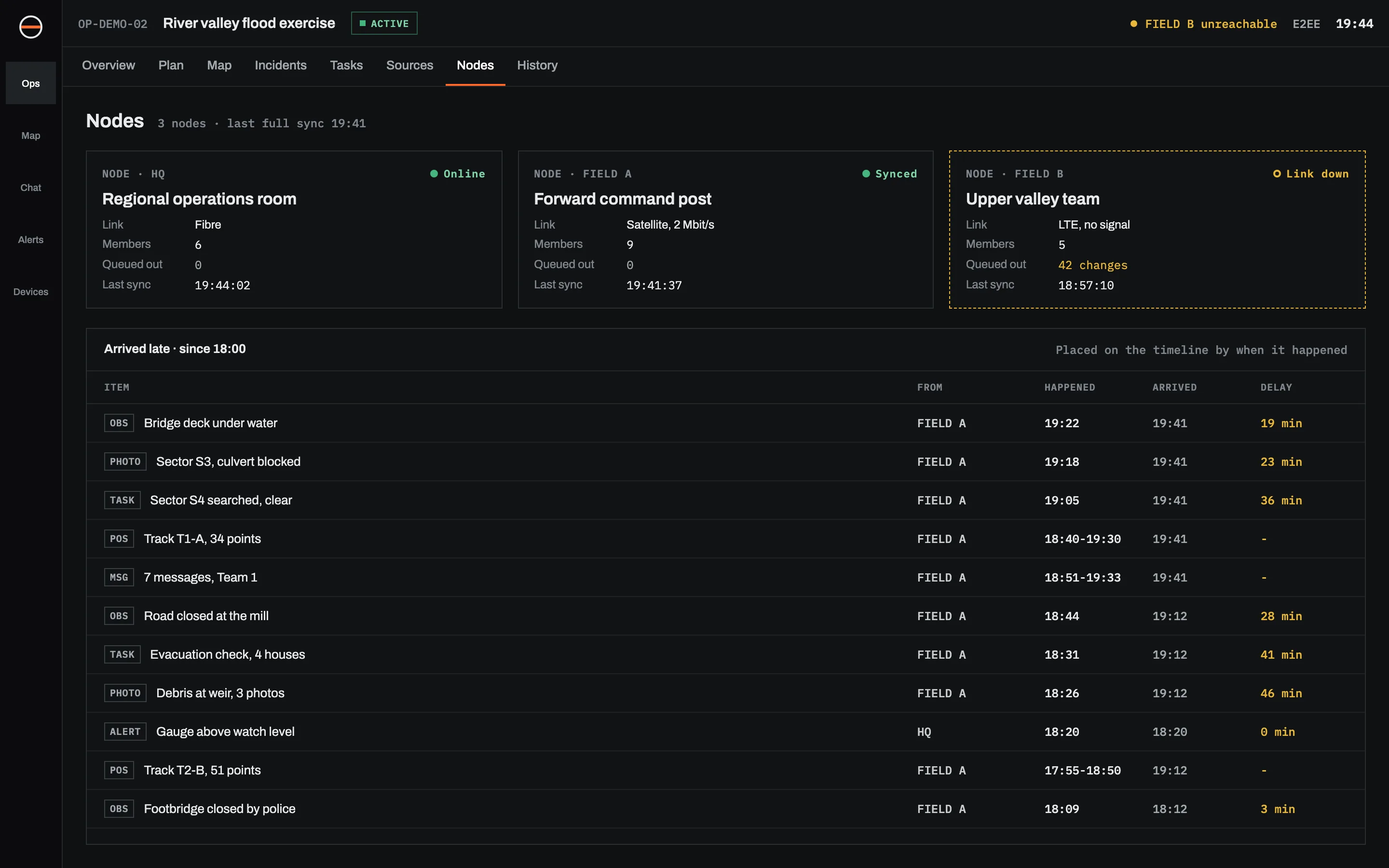
Hour 9A link comes back at the depotThe water company’s depot gets a satellite link. Its node syncs with headquarters; late reports go onto the timeline at the time they were made.SyncTwo timestamps
-
Hour 30Switch to plan BAn inject closes the bridge. The plan check shows plan B still has enough drivers; the switch is recorded with who decided and why.InjectsDecision points
-
Day 4Debrief from the recordPlan versus actual, gaps in coverage, findings with owners and deadlines.DebriefLessons learned
Built for organisations that have to keep going.
Works without the network
Phones work offline with maps, tasks and team lists. A disconnected node runs a whole operation on a laptop with no internet.
One picture across organisations
Council, utility and charity in one operation, each with its own roles. Partners join as time-limited guests.
Plans you can rehearse
Plans with objectives and alternatives, what-if rehearsal, and a training mode that keeps exercises clearly apart from real events.
Logistics in the same place
Inventory, consumables, vehicles and generators with expected and actual location.
Working alongside the military
APP-6 military symbols next to civilian ones, MGRS coordinates, and two-way Cursor on Target exchange with TAK-family apps. See civil-military cooperation.
Where your data lives
Hosted in the EU, on your own servers, or fully disconnected. Messages and files are end-to-end encrypted. Details on the security page.
Where Sinkaos stops.
No certification or accreditation
Sinkaos is not NATO-certified or accredited and is not approved for classified information. It is a tool for unclassified civilian coordination.
Not a warning or dispatch system
Emergency Alerts, flood warnings and 999 calls stay with the national systems and the emergency services.
Not a compliance guarantee
It helps you plan, exercise and document. Meeting your duties under the Civil Contingencies Act or the NIS Regulations remains your organisation’s work.
Phones still need power
Offline mode handles a missing signal. Flat batteries are another matter, so plan charging.
What it gets used for.
What people ask about civil preparedness.
Is Sinkaos a military system?
Can it run if the internet is down for days?
Can several organisations work in one operation?
Does it help us meet NATO or UK government expectations?
Try it on your next operation.
Early access is free. We set up the first operation with you and stay close while you use it.