End-to-end encrypted team messaging that belongs to the operation.
Encrypted team messaging in Sinkaos lives inside the operation: one channel for everyone, one for each incident, and direct messages. Messages, photos and files are end-to-end encrypted, and when the operation closes, its conversations close with it.
The team chat runs on private phones and private numbers.
Most teams coordinate in a consumer messenger because everyone already has it, and that has a cost. To add a volunteer you need their private phone number. Group membership drifts, and people from last year’s event are still reading this year’s chat. Photos of injured people and addresses sit in personal galleries long after anyone needs them.
There is also no link between the conversation and the work. A report of a blocked road is a message among hundreds. Whoever reads it has to copy it somewhere else, and the person who sent it never learns whether anyone acted on it.
A water rescue exercise with a partner organisation, from eight until lunch.
-
08:00Partners join without swapping numbersTwo water rescue teams from a partner organisation join the operation as guests by link. They sign in with a password or passkey; nobody hands out a phone number. Their access is limited in time and scope.GuestsNo phone number
-
09:20One channel per incidentA capsized boat is opened as an incident. Its own encrypted channel starts with the boat crews and the operator in it. The operation-wide channel stays quiet enough to read.Incident channelsMentions
-
09:24A message becomes a taskA crew lead writes that the far bank needs a second team. The operator turns the message into a task, places it on the map and assigns it. The original message links to the task.Message to taskMap
-
10:05Photos, without the wrong metadataA photo of the casualty goes into the incident channel, encrypted on the phone before it leaves. Under the operation’s policy, its location metadata is stripped. On a weak link, low-bandwidth mode lets text through first.Encrypted mediaMetadata policyLow bandwidth
-
12:30A lost phone, revokedA volunteer’s phone goes into the river. The operator revokes the device. It receives nothing new, and what it stored remains behind its screen lock and local encryption.Device keysRevocation
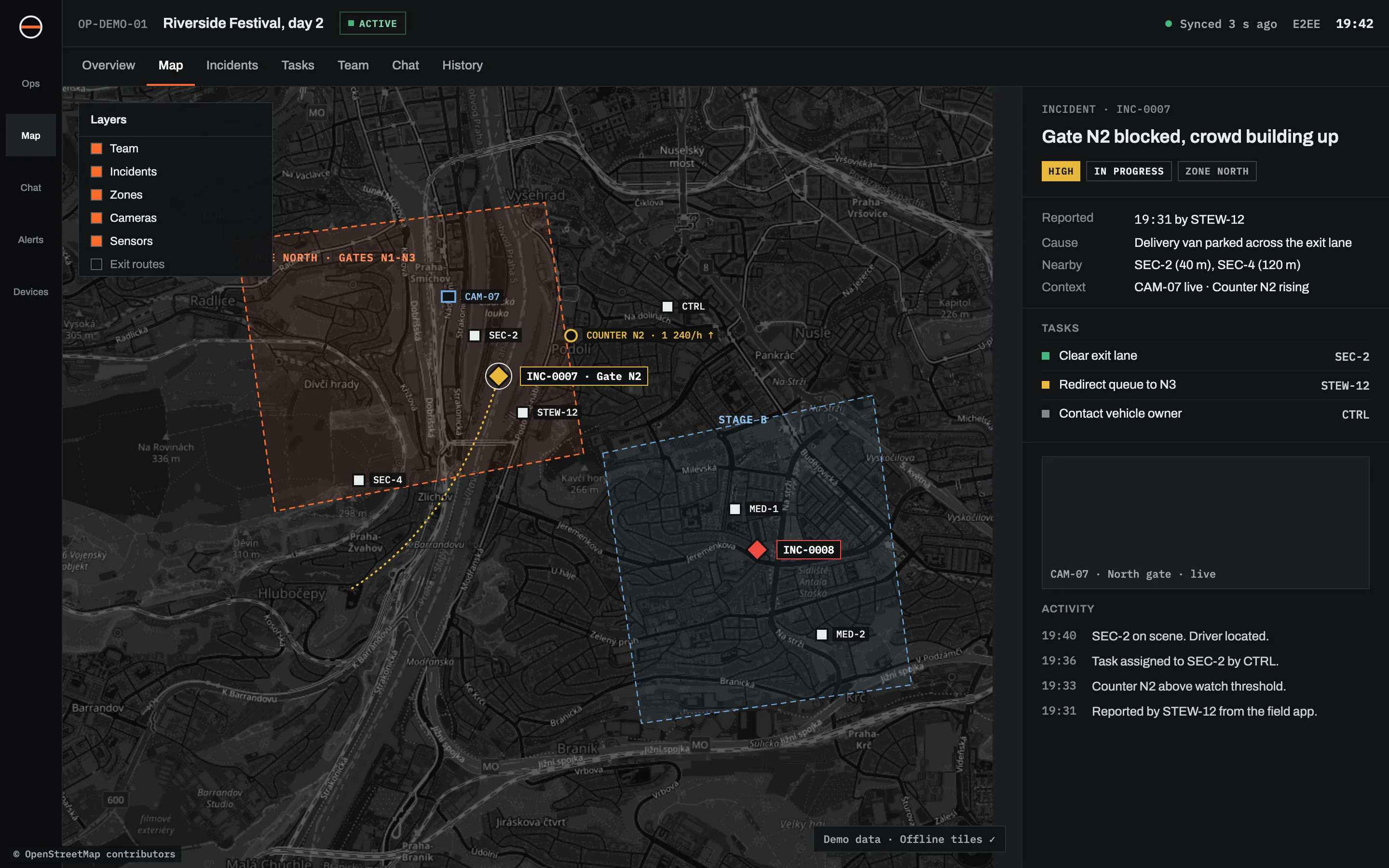
Messaging that knows which operation it is part of.
End-to-end encrypted chats
Direct and large group chats, with messages, photos and files encrypted on the device.
Channels that follow the work
One for the whole operation, one for each incident, and direct messages. Places, incidents and tasks shared into a chat stay the same object.
Keys per device
Every phone and browser has its own key pair. Verify a device by QR or safety code, and revoke one that is lost.
No phone number needed
Sign in with a password, passkey and authenticator app, or your organisation’s single sign-on.
Encrypted calls
One-to-one and group voice and video calls.
Disappearing messages
Messages and attachments that expire, with clear wording about what can and can’t be removed from other devices.
Quieter on a bad link
Low-bandwidth mode holds back photos and video so text and alerts get through first. Messages written offline are queued.
Search that stays on the device
Search inside encrypted messages runs on your phone, so the server never needs to read them.
What the server can and cannot read.
End-to-end encryption covers specific kinds of data. This is the split, as published on our Security page.
| DATA | PROTECTION | WHAT THE SERVER SEES |
|---|---|---|
| Messages | End-to-end encrypted | That a message was sent, by which device, to which channel, when, and its size |
| Photos and files | End-to-end encrypted | File size and when it was sent |
| Incidents, tasks, map objects | Encrypted in transit and at rest | The content, so it can sync and raise alerts |
| Positions | Encrypted in transit and at rest | Positions of members who are sharing |
What encrypted messaging in Sinkaos does not do.
Teams that use it.
Questions about encryption, accounts and privacy.
Is everything in Sinkaos end-to-end encrypted?
Do people need to share a phone number?
Can the service operator read our messages?
What happens to messages when the operation ends?
Does it work without signal?
Why not just use Signal or WhatsApp?
Try it on your next operation.
Early access is free. We set up the first operation with you and stay close while you use it.