Training and exercises built from the plan you would actually use.
Sinkaos turns a real mission plan into an exercise, marks everything in it as training, and keeps every attempt so you can compare them. TRAIN sits between RESOURCE and EXECUTE in the Sinkaos loop, and what an exercise finds goes back into your world model.
- PREPARE
- TRAIN
- LEARN
- CHANGE THE WORLD MODEL
The exercise happens once, and the report goes in a folder.
The scenario is written in a document that has already drifted from the live plan. Someone on the control team reads injects from a spreadsheet, evaluators keep their notes in a notebook, and the radio traffic sounds much like the real thing, so anyone joining late has to ask. A few weeks on, a report lists what went wrong. Six months later the plan is unchanged and the next exercise finds the same gap.
In England and Wales, the plans of general Category 1 responders must provide for exercises and for training, so that the plan is effective (regulation 25 of the 2005 Contingency Planning Regulations). GOV.UK guidance adds that plans should state the nature and frequency of both. The UK Resilience Academy’s non-mandatory Exercising Best Practice Guidance covers the range from a table top exercise to a full LIVEX. How a finding reaches the plan is left to each organisation.
One flood exercise, from the real plan to the changed plan.
-
Week 1The plan becomes a scenarioThe exercise lead turns the care home evacuation plan into a training scenario. The original plan stays as it was. She splits the scenario into four segments: briefing, staging, ground floor evacuation and handover to the rest centre.ScenariosSegments
-
Week 4The site moves to a training groundThe care home cannot host the exercise, so its staging area, entrance, stairs and rooms are mapped onto a fire station drill yard. Signal there is poor, so the scenario, maps, people and injects go into a training pack that runs on a local network.Different venueOffline exercises
-
Sat 09:00Training mode goes onEvery screen shows that this is training, and simulated events cannot trigger real actions. The instructor runs the scenario, two evaluators assess, and the safety officer holds separate controls to pause or abort.Training modeRoles
-
Sat 10:40An inject forces the branchThe instructor injects a flooded access road and stands in for the ambulance service, which is not taking part. The team has to find the alternative route, and the scenario branches.InjectsBranches
-
Sat 11:30Reset and run it againThe ground floor took too long. The instructor resets that segment and reruns it with a different team leader. Both attempts are kept, with timing, routes, tasks and interventions side by side.Reset and retryCompare attempts
-
Week 6The finding changes the planThe evaluation shows the stairs as the bottleneck, with the evidence attached. In LEARN the finding gets an owner. In CHANGE THE WORLD MODEL it proposes a second evacuation chair on the kit list and a new step in the plan.EvaluationLessons
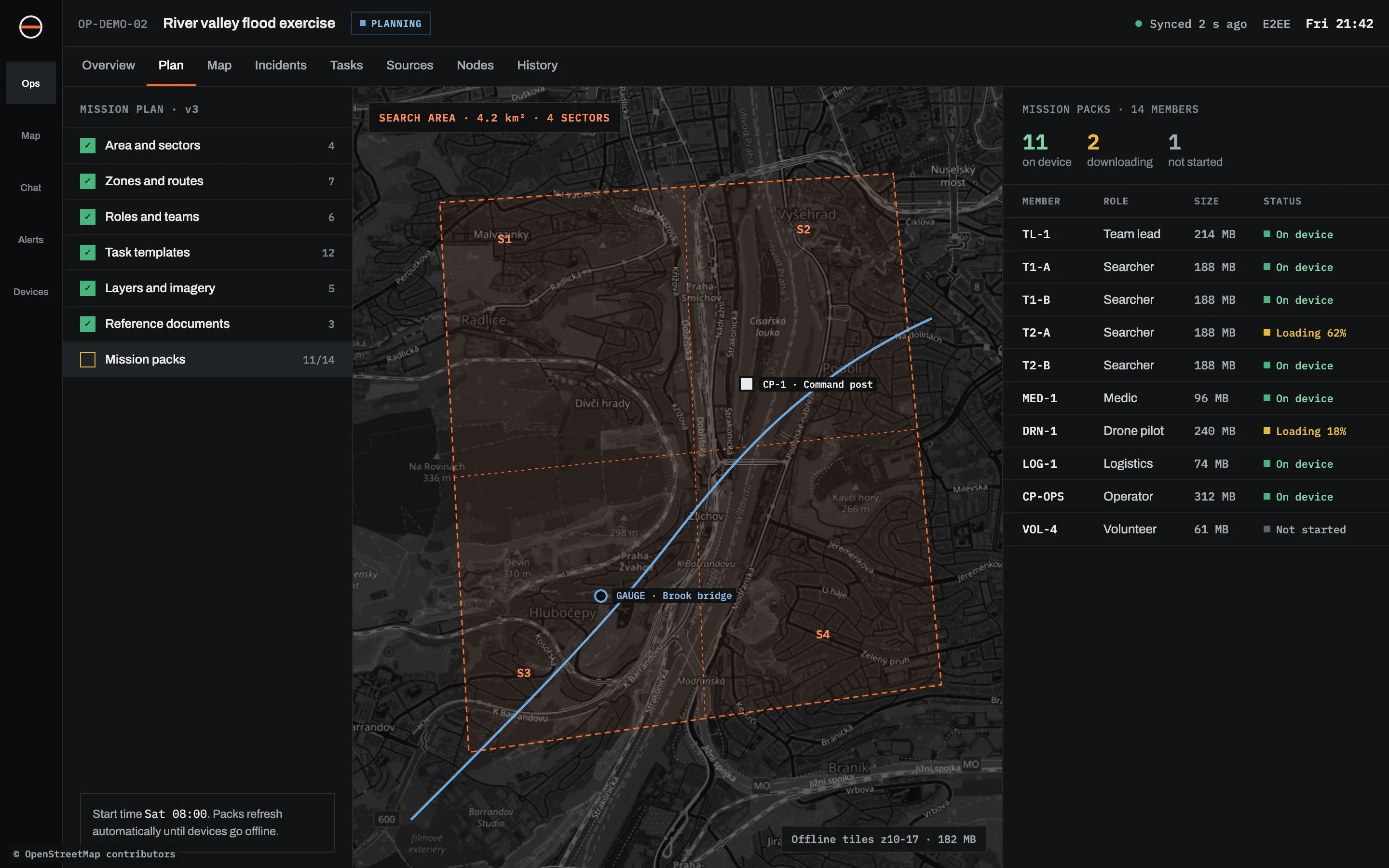
Exercise management tools for instructors, evaluators and trainees.
Training mode
Clearly marked exercises where simulated events can’t be mistaken for real ones or trigger real actions.
Scenarios from real plans
Turn a mission plan into a scenario without changing the original.
Repeatable segments
Practise, simulate, brief or skip each part. Reset a segment and run it again.
Different venue
Map the real site onto a training ground, down to the staging area, entrance, stairs and room.
Injects and branches
Inject events, stand in for missing people or systems, and branch the scenario.
Separate roles
Instructor, evaluator, observer and safety each get their own controls.
Evaluation with evidence
Assess against clear criteria and keep the proof, so nobody is reduced to a single score.
What you can show afterwards, and where it comes from.
| QUESTION | IN A REPORT AND A NOTEBOOK | IN SINKAOS |
|---|---|---|
| Did we exercise the plan we would really use? | If someone compared them | The scenario is made from the plan |
| Was the second attempt better? | Memory and a stopwatch | Timing, routes, tasks and interventions across runs |
| Who moved where? | Usually lost | Real movement against the planned route, including floors and rooms |
| What is the assessment based on? | An evaluator’s notes | Clear criteria, with evidence |
| Did the finding change anything? | Depends who follows up | Lessons with an owner, and proposed changes to plans, training and kit |
What training in Sinkaos does not do.
Exercises and courses it fits.
Questions about training and exercises.
Can a simulated event set off something real?
What happens if a real emergency starts during an exercise?
Can we exercise somewhere without internet?
Does it suit a table top exercise?
How do findings get back into the plan?
Try it on your next operation.
Early access is free. We set up the first operation with you and stay close while you use it.